Fragment of a Coptic Demonological Text
I suspect many are familiar with the famous early grimoire, the Testament of Solomon. Composed between the 1st and 3rd centuries CE, it is most widely known in Russian through Chester C. McCown’s reconstruction. This translation is often presented as an original manuscript, though it is merely a composite text assembled from several versions. Modern works based on McCown’s text are sometimes appended to it as well. While McCown’s 1922 compilation was excellent for its time, it naturally lacks access to manuscripts that were unavailable then. Furthermore, a number of extant manuscripts echo the Testament without being part of it. We must not forget that the Testament influenced the entirety of Western demonology and provides a key to understanding a vast layer of information regarding malefic magic. In this context, I would like to recall the description of a demon found in a heavily damaged Coptic manuscript.
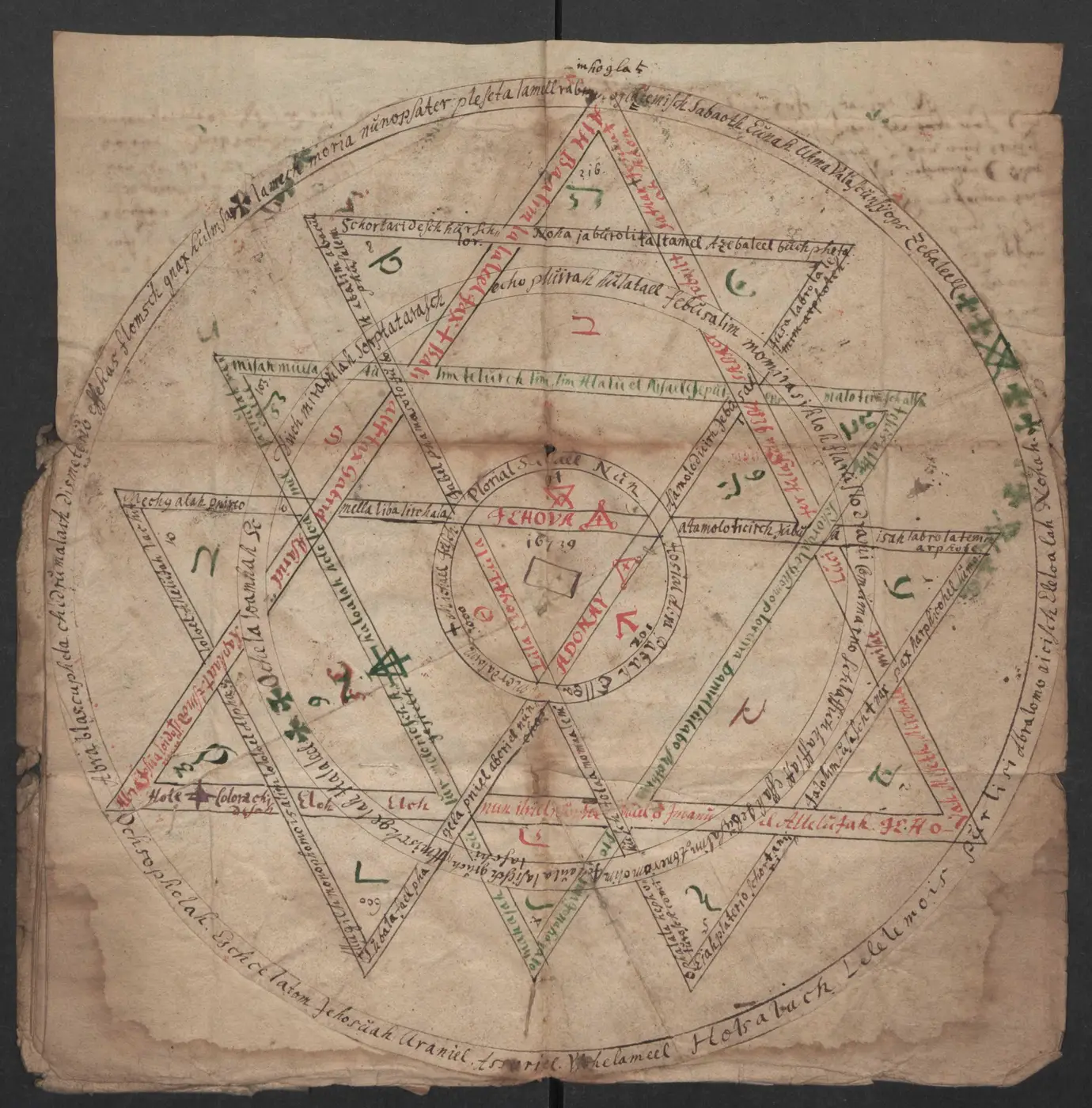
Interestingly, while the description mirrors the Testament, the demon itself is not mentioned in the main text. The manuscript also describes a ritual for cursing a specific location, whereas the Testament typically focuses on methods for exorcising demons. Finally, the text includes a spirit seal that vaguely resembles a Goetic sigil. Given that the text dates to the 10th or early 11th century, it stands quite close to the undiscovered Proto-Key of Solomon from which the later Greater and Lesser Key treatises would emerge. A significant number of such fragments are held in various collections and museums.

Comparing and translating the existing manuscripts and fragmented texts would certainly be an interesting endeavor, though it would require significant time and resources. Nevertheless, I hope to undertake this work one day.
Regarding the text I am translating below:
Location: Institute for Papyrology, Heidelberg (P.H.K.4). Held in the Heidelberg papyrus collection since 1935.
Language: Coptic (Sahidic with Fayyumic influence).
Place of origin and discovery: Middle Egypt.
Where gaps appear in the text, they are marked with […].
Square brackets containing numbers refer to the footnotes.

Judging by the described method, one must draw a symbol in blood upon a specific tablet. Then, wash it off with dirty water and pour this mixture over the threshold or door of the house to which you wish to bring misfortune in business. The incantation to be recited during this process is heavily corrupted, yet other sections of the manuscript remain quite intriguing.

Translation.
(see the figure, the seal, and the description of the method)
Solomon gave thanks.
Khubin Harpak <Χουβιν Ϩαρπαχ> entered before him.
Solomon asked him: "What is your business?3".
He replied: "My business is destruction; I have never done anything good, ever. All evil things follow me. I destroy the threshing floor. I destroy the winnowing shovel. I lay waste to the water wheel. I destroy the garden. I destroy
[…] I ruin it. I destroy the storehouse down to its doors. The water tank, I destroy it.
[…] to a man, all that is evil, I bring to him
[…] by the great power of Esan, my great power4
[…Kh]ubin Arpach is my name, Ornetau
[…] is my name, Arpach is my name, Ornetau is my5
[…] all that is evil, whatever you ask of me, I
[…] listen to me, Sanatael and Setrak6
[…] Ai, aia, now, now!7
Loading comments...
Sign into leave comments.