The Halle Grimoire: A Dialogue Between Marcus Antonius and Judah ha-Nasi on the Names of God
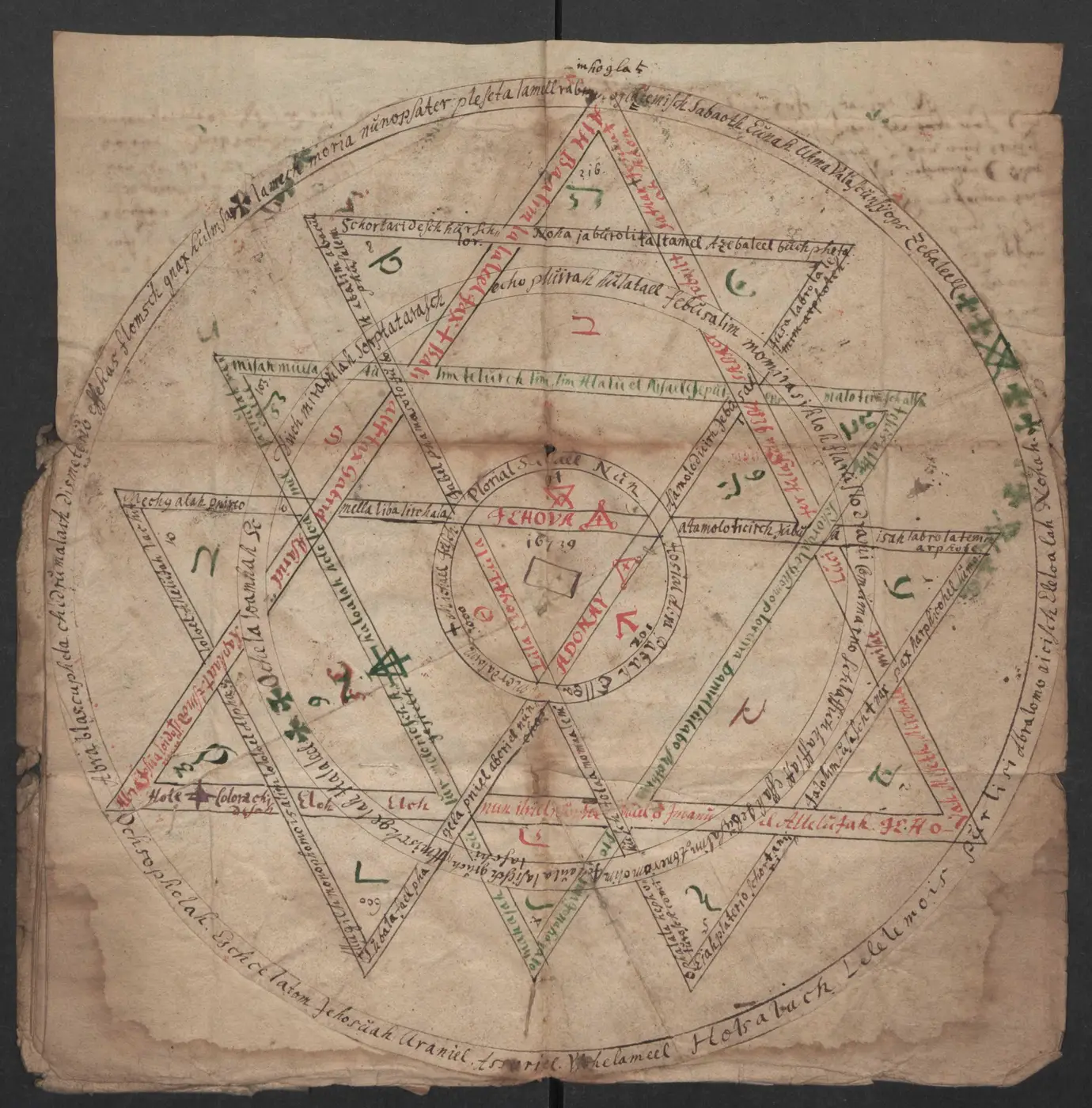
After completing work on The Kabbalah of the Ancients, I felt compelled to translate something on the same subject. I selected a short treatise from a large collection of magic held at the University and State Library of Saxony-Anhalt (Halle), cataloged as 14 B 36, though better known as the Hallesches Zauberbuch (Halle Grimoire). The manuscript dates to 1400–1450. It is a massive compilation of over 800 pages containing both well-known and unique practices. However, the specific text I wish to describe here spans a mere seven pages (364r–367r).
Like many texts of its era, it is structured as a dialogue between historical figures, though in reality, no true dialogue takes place. Naturally, it capitalizes on these famous names. At the very beginning, the seeker of wisdom is Mark Antony, known to many through the story of Cleopatra, who approaches none other than Rabban ha-Kadosh, or Judah ha-Nasi. The venerable Antony is not in the least troubled by the fact that he should have been dead for nearly two hundred years—evidently, being a three-time Roman consul has its advantages.
The text offers a unique perspective on the 4-letter, 12-letter, and 42-letter Names of God, which is precisely why I found it so compelling. It draws heavily upon the ideas of Maimonides, even including a full citation from his treatise where he quotes Rabbi Tarfon. True to the style of the period, the source is filled with obscure, veiled passages, and certain ideas remain hidden behind the ornate prose. The text also features brief marginalia that serve as signposts, clarifying the content of each section—the first of which is a prime example.
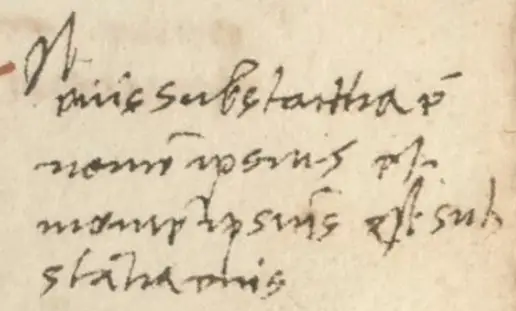
These marginalia merely repeat the key point of the paragraph, often verbatim or with only slight variation; therefore, I have omitted them. The end of the text contains certain ciphers representing formulas of the Names of God in various magical alphabets, including Transitus Fluvii. I have not deciphered these. The remaining Divine Names mentioned in the material are as follows:
The Four-Letter Name: יהוה1;
The Twelve-Letter Name: אב בן ורוח הקדש2;
The Name of Forty-Two Letters: אב אלהים בן אלהים רוח הקדש אלהים שלשה באחד אחד בשלשה3;
Of particular interest is the Name of the infinite hypostasis of God: אל אלהים אלוה אדני4;
The Forty-Eight-Fold Name;
It also lists the names of the 72 Genii, which are linked to the single, unified Name of God.
And a few more Names, included for clarity.
I believe that covers the text; we can now proceed to the translation itself.
Translation
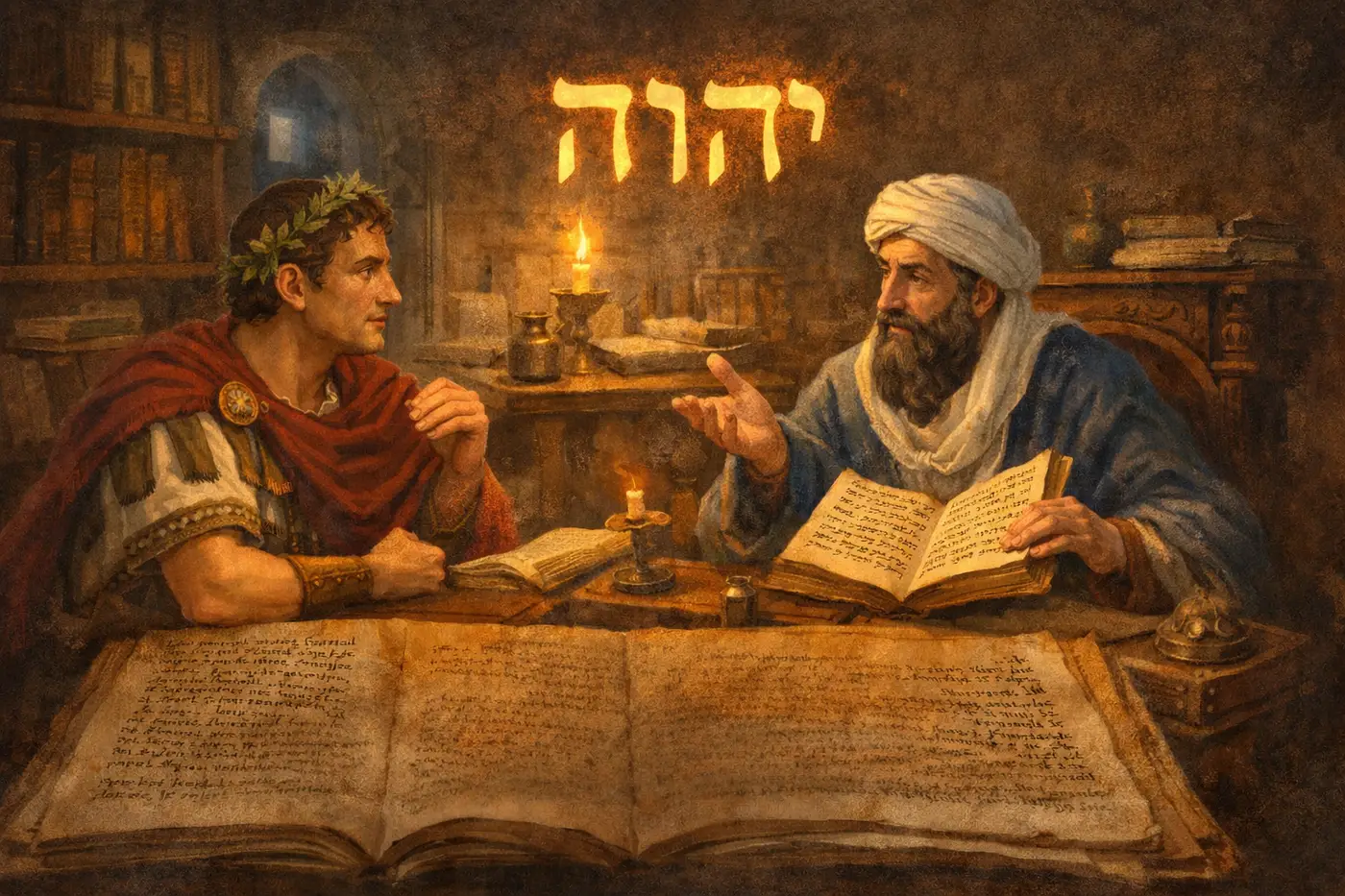
Once, Antonius, Consul of the City of Rome [Antoniůs Consůl Urbis Romae], came to Rabban ha-Kadosh [Rabano Hachados] seeking instruction in the Truth: what is the meaning of the four-letter name [nomen qůatůor literarum], or Tetragrammaton [Tetragram̃atõ]? He also inquired about the names of 12 and 42 letters [nomen xij et 42].
He replied:
You ask to be instructed in the Truth revealed by the names of 4, 12, and 42 letters. Know that this is the mystery of God [canům Dei] which must be hidden from all men. However, since I recognize you as one of the worthy Scholars [Scholasticis], it is reasonable to reveal such things to them, for to men of this kind, such mysteries are by no means hidden. Therefore, know that God has no proper name [Deum non habere nomen proprium] that we could ever know, for His very Essence is His name, and vice versa. Just as we cannot possess knowledge of His Essence—for in knowing it, we would become like Him—so too can we not know His name. Nevertheless, His names are attributive [attribůtiuå]. The four-letter name, through His attributes, reveals a most glorious knowledge [præclariůs ostenditꝗ́ notitiam], more perfect and more fitting to Him, insofar as it is accessible to our understanding. From it, all His other names proceed. Thus, this name is called Shem HaMephorash [Semhameforas], not because it is His substantial name in itself [eiůs nomen substantiale], but because we speak of it as the limit of what our capacity can grasp, beyond which we cannot ascend.
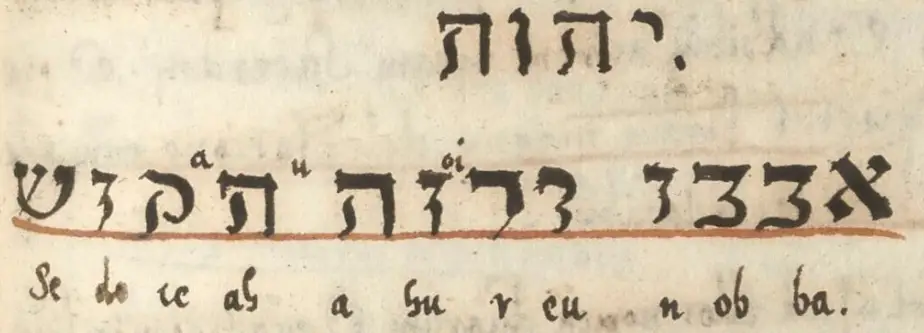
You must also note that the 12-letter name and the 42-letter name are not names where each individual word consists of 12 or 42 letters. Rather, each is composed of distinct words that manifest the One. Having revealed this to you, observe the 4-letter name and how it is written. In Hebrew, it is written thus: יהוה, that is, Jehovah [Joůa], which demonstrates God Himself as the Begetter. Since there can be no begetter without the begotten, Love must necessarily flow from the begetter to the begotten and vice versa. For if this were not so, He would not beget, and love would not flow from the begotten to the begetter; He would be separated from Him, and there would be two essences. We, however, posit the begetter and the begotten as being of one essence [unam Sůbstãtiãm esse]. Therefore, love must necessarily flow from one to the other. It is from this Shem HaMephorash that the 12-letter name was derived [derivåtum est nomen xij literarům]. This is the Father, the Son, and the Holy Spirit [Pater Filiůs et Spiritůs Sanctůs], which in Hebrew is written with twelve letters5, in this manner, namely:
Since there is nothing in God that is not God Himself, the 12-letter name gives rise to the 42-letter name, which is: Ab Elohim ben Elohim růha haccados Elohim Selossa beehad ehad beselossa6.
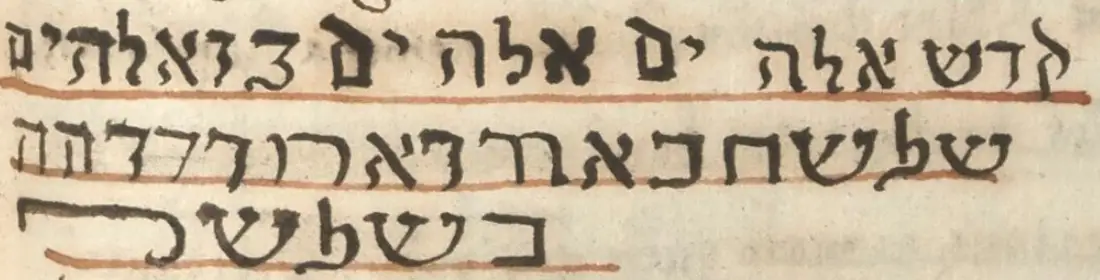
This constitutes 42 letters in Hebrew [xlij lraẽ]. It signifies [significatꝗ́] God the Father, God the Son, and God the Holy Spirit—the Trinity in Unity [Trinitatem ni Vnitate] and Unity in Trinity [Vnitatem ni Trinitate].
You must realize that these names originate from divine mysteries, which must remain hidden from everyone until the coming of the Righteous Messiah [Messiás Iůstůs]; in them, I have revealed to you those very hidden things.
Rabbi Moses Maimonides [Rabi Mossae Ægyptiůs] in the first book of The Guide for the Perplexed [More Hanevuchim], or Instruction for the Wavering [directionis nůtantiũ], chapter 72. His words are as follows:
Rabbi Tarfon said: Once, while following my father into the Temple, I pressed my ear against a priest and noticed that he was murmuring indistinctly [heram] with great care while the other brother-priests were chanting.7
They possessed a name of forty-two letters [důarům et qůadraginta lrãꝗ́]. Anyone of sound mind knows that a single word cannot possibly consist of forty-two letters; rather, these were many names composed of forty-two letters. There is no doubt that these names signified certain meanings [ronẽs] that lead a person to the Truth of the Creator’s Substance in the manner we have described. It was held that all these numerous names were one name, for they denoted One Essence, much as other names are derived from works. Yet there were many such names so that a meaning might be grasped which perhaps could not be understood otherwise than through many Words. Note this well and observe that the thing they reveal—the Knowledge of the things those names signify—was never a matter of mere verbal literacy. It is said that the twelve-letter name and the forty-two-letter name are separate names [nõiae separata], as is the separate name, distinct in itself, as we have already stated and explained. Other names served as a great aid to man in knowing the Creator, as evidenced by the Sages who say: “The forty-two-letter name is holy and sanctified [nomen xlij literarům est sanctům & sanctificatũm].” It is not revealed to anyone except the humble, those who have passed more than half their life, who are in no way wrathful, not prone to drunkenness or vicious habits, but are instead gracious. Whoever possesses the knowledge of this name, guards it, and keeps it in purity is loved by those above and desired by those below; Creation trembles before him, his teaching remains eternally in his hands, and he shall inherit two worlds: the Present [Pntẽm] and the Future [fůtůrũm].8
The seventy-two holy names [Septuaginta duo nomina sacra], which constitute the one Shem HaMephorash—that is, the most holy name of the Tetragrammaton, known as the Manifest—must be invoked with fear and trembling through the Invocationes Angelorum by those who are devout and dedicated to God.
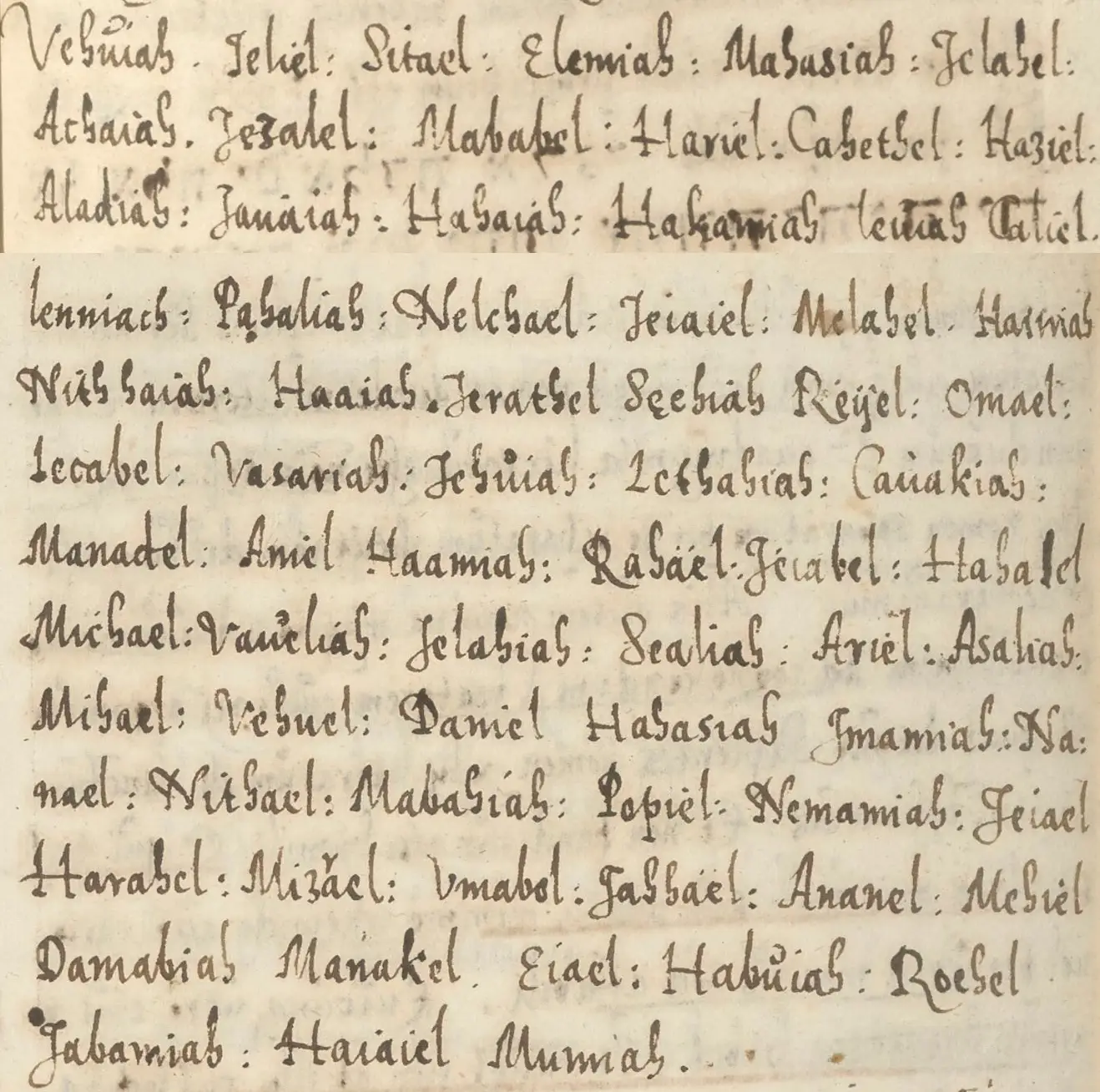
For the Seal of God [Sigillům Dei] is Yahu [יהו]. With it, Ehihe [Ehihe] sealed the world [sigillaůit můndům]; it is called "אמת", that is, Truth9, and it signifies the True Primal Essence [Veram Essentiam primam significat] — Yah: "יה".
When Moses asked, "What is His name? What shall I say to them?", <***God***> replied: "Ehieh" [Ehieh]. Consider carefully the words of the Holy Spirit [Spiritůs Sancti Verba], which are not placed in Exodus 3 in vain: "מה שמו מה לי" (What is His name?). Observe their final letters, and you will obtain the ineffable Four-Letter Name "יהוה", whose source is Ehieh10, whose middle is Yah, and whose end is infinity [infinitũdo]:


Consequently, for Kabbalists, these twelve names11 signify a single Name, as they all point to the same Essence.
Loading comments...
Sign into leave comments.