Creating Baron Urbigerus's Herbal Menstruum, Part 1
Introduction
Some time ago, I stumbled upon a fascinating article by Professor Manfred M. Junius1—a brilliant researcher and practitioner across various fields of Hermetic philosophy. The text serves as a commentary and guide to working with a vegetable solvent authored by a 17th-century German baron, Urbigerus. The purpose of this menstruum is clear: the cold extraction of a plant's philosophical oil.
This oil itself should be a highly potent spagyric preparation, as the "cold way" implies the subtle treatment of the substrate that aligns with a "feminine" approach—gentle and reverent, in contrast to thermal processing. In spagyrics, this is of paramount importance: vegetable matter does not tolerate coarseness.

An illustration depicting the Sacred Great Work
Given my experience with elixirs and tinctures, I could not ignore this particular formula; it sparked a truly childlike wonder in me. The culmination of the work was to be a solution into which one could submerge any* green plant, and within mere minutes, a film—the purest oil—would rise to the surface, while all impurities would mysteriously settle to the bottom.
Although the process itself did not seem like a walk in the park—quite the contrary, as I faced a long and thorny path for the first time, involving a specific cohobation, a month of preparing the matter, and much more—I nonetheless decided to proceed with this experiment.
Preparatory Stage
The very structure of the menstruum is fascinating: it is prepared Mercury, saturated with an abundance of Sulfur and Salt. This sounds like a standard approach to elixir preparation, and in many respects, it is—with a few notable exceptions.
In our work, Mercury is rectified spirit of wine, while Sulfur is of a dual nature: volatile and fixed. Volatile Sulfur is turpentine derived from coniferous resin, and fixed Sulfur is rosin—that same resin. Salt is the highly purified body of tartar.
The essence of the work lies in saturating Mercury in a specific manner, fully imbuing its internal structure with the aforementioned substances to render it igneous, which yields the desired result. Once the matrix of Mercury is saturated, it can no longer absorb ethereal compounds and oils, forcing them to the surface. The sharpness and igneous quality are imparted by the excellent salt.
Our preparations will proceed as follows: we shall combine rosin and turpentine in a 1:2 ratio. While one may experiment with different proportions—I have achieved results even with a 1:4 ratio—I find the 1:2 mixture to be the most effective. The rosin, or abietic acid, will serve as our saponifying agent for the salt, while the turpentine will penetrate the Mercury, nourishing it to fullness.
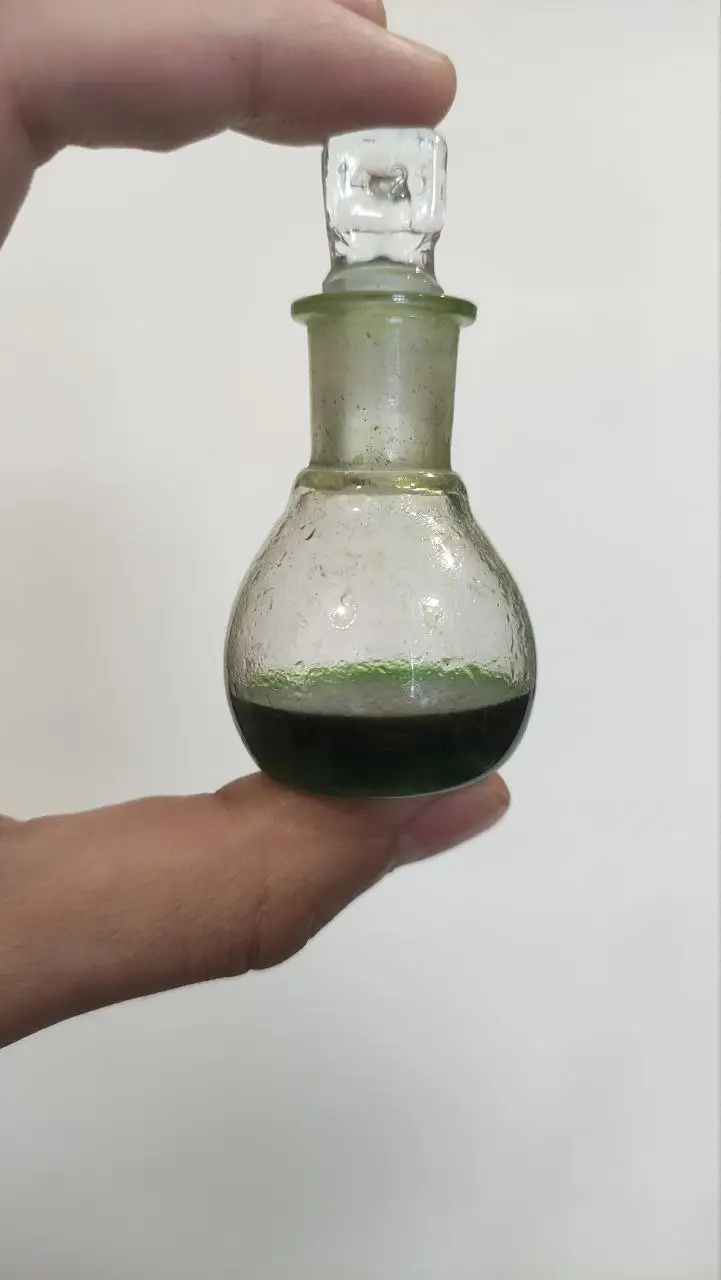
Rosin and turpentine will serve as nourishment for our future infant. Prepare the mixture by combining both ingredients in the specified proportions over a water bath until fully integrated. The result will be a thick, amber-colored solution. Ensure the rosin is crushed into a fine powder beforehand.
Thoroughly heat the pre-purified Salt of Tartar and allow it to cool only slightly to prevent ignition upon mixing. The quantity of Salt must be sufficient; for 250ml of vegetable menstruum, I recommend at least 50g of purified Salt. This ensures the fiery nature of our Mercury remains well-tempered.
Now we can perform the first conjunction: add a small amount of our nourishment to the dry Salt, just enough to barely cover the layer. The key is not to overdo it. Store the mixture in a tightly sealed container, protected from sunlight.
We now have an infant that must be fed daily until it is fully satiated and refuses further nourishment. Beyond feeding, you must "turn" it daily—stirring the substance—to prevent it from stagnating. I advise treating it with a mother's love, as the final result truly depends on this. If the infant has not had its fill within three weeks, an error was made somewhere along the way.
In the next part, I will describe in detail how our Elixir is born from this infant.
Loading comments...
Sign into leave comments.