The Nature of the Sephirot in Kabbalah

The Sephirot (plural of "Sephirah") represent the most fundamental concept in Kabbalah, appearing consistently across its literature from the earliest texts to the present. While we will address the etymology and historical development of the term in a future article, here we shall examine the nature of the Sephirot and why they remain a subject of debate and divergent interpretation.
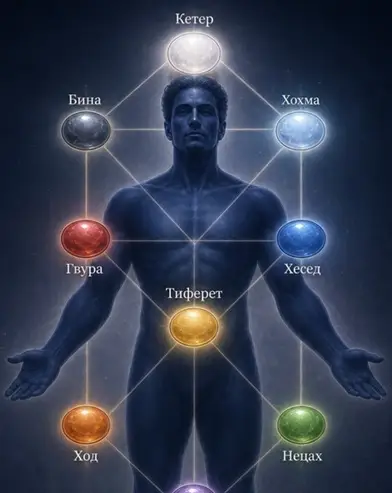
The Tree of Sephirot (or simply the "Tree of Life") is the most well-known model in Kabbalah. It arranges the Sephirot into three vertical lines, or pillars, illustrating not only their relative positions but also the dynamic transitions between them in the form of connecting paths, or channels. However, Kabbalah is not limited to this tree and everything mapped upon it. Kabbalah reveals the ontological sequence of stages that resulted in the formation of this tree. At different stages, the Sephirot were arranged differently, played varying roles, and often carried distinct meanings. Yet, one should not fall into extremes here: these differences do not imply a total lack of connection or correspondence between the Sephirot across these stages. Rather, their meaning was most general and fundamental in the initial stages, whereas later, that same meaning found more concrete expression as it entered a more specific context.
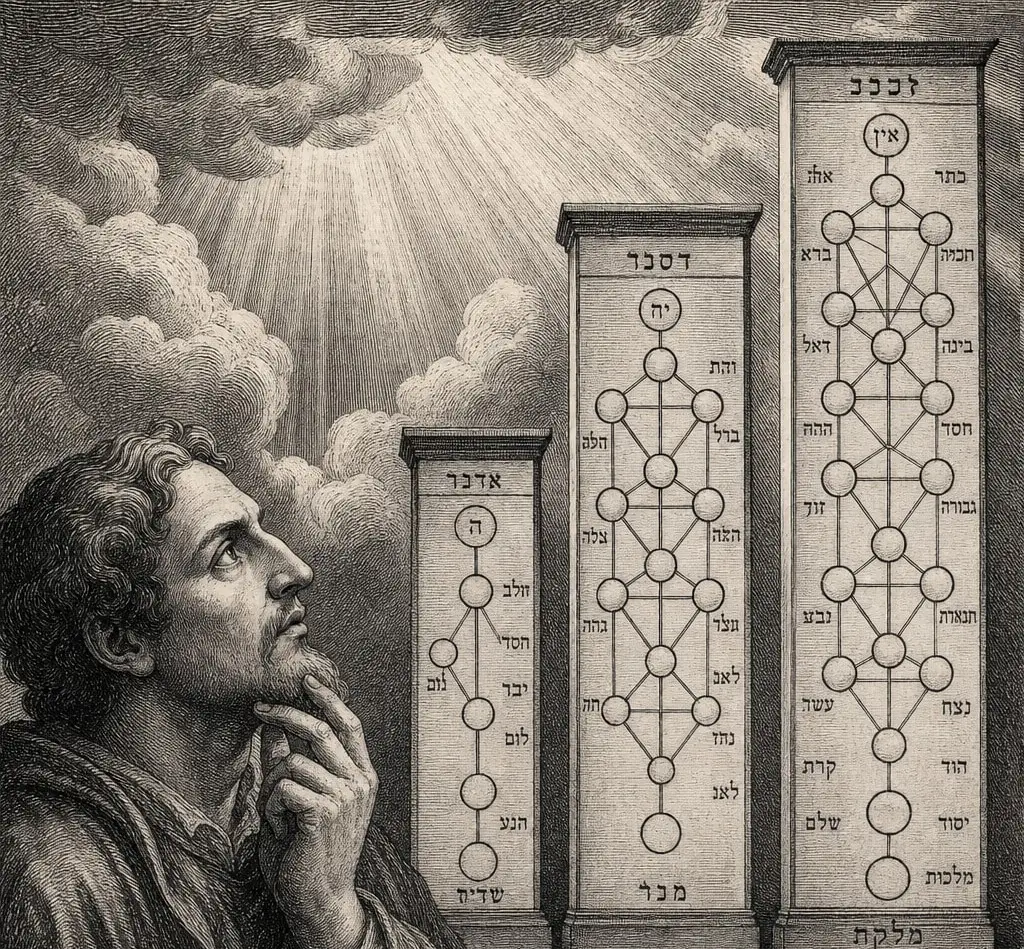
To illustrate this, let us consider the three worlds mentioned in Kabbalah: Akudim, Nekudim, and Berudim. Regarding the Sephirot in the world of Akudim, it is said that they were all aligned in a single column—a configuration quite unlike the familiar three-pillar Tree of Life—and possessed only one vessel, Malchut. The remaining Sephirot lacked their own vessels; thus, the entire system is described as "ten lights in a single vessel."
In the world of Nekudim, the Sephirot are structured differently. The first three are arranged along three lines—right, left, and middle—while the remaining seven are aligned in a single column (as in Akudim). Here, each Sephirah acquires its own vessel; yet, it is also here that the well-known shattering of the vessels (Shevirat HaKelim) occurs, because in this world, there are "great lights and small vessels."
In the world of Berudim (Atzilut and beyond), the familiar Tree of Sephirot with its three pillars emerges. Here, the Sephirot are balanced, establishing a system of compensations and safeguards that prevents the recurrence of the Breaking. These features become embedded within the very organization of the Sephirot.
Clearly, if we were to discuss the meanings and interpretations of each individual Sephirah, our conclusions would depend heavily on the specific World and state in question. What holds true for one state may not apply to another. This is one reason for the misunderstandings and the multiplicity of interpretations surrounding the Sephirot—a labyrinth in which a beginner can easily lose their way.
A second reason is that authors often conflate the Sephirot and their primordial meaning with the various phenomena that correspond to them. The system of the Sephirot is not merely a description of how desire manifests; it is a method for mapping the connections and relationships between the multitude of analogous objects distributed throughout this system.
In Kabbalistic literature, for instance, one finds a multitude of correspondences for each Sephirah. These include parts of the human body, colors, planets of the solar system, letters of the Hebrew alphabet, Divine Names, angels, and demons. More specialized sources further correlate the Sephirot with metals and gemstones, cardinal directions, religious commandments, and so forth. Within the Western occult tradition, the Tarot trumps are mapped onto the Tree of Life, while in magical practice, each Sephirah is associated with specific geometric figures, types of incense, and ritual implements.
Often, an author who does not aim to explain Kabbalah but uses it merely as a system of attribution and correspondence will simply equate a Sephirah with the concept assigned to it. For instance, they might say, "Chesed is the right arm," or "Gevurah is Mars and the color red." Clearly, one should not take these statements so literally as to believe the right arm is the Sephirah Chesed. It would be more accurate to say that within the system of the Sephirot, Chesed corresponds to what the human body represents through the right arm. While experienced students of Kabbalah do not require such clarifications, less experienced and more naive practitioners easily fall into error, beginning to substitute the Sephirot with these external concepts. It is no surprise, then, that common misconceptions arise—such as the belief that Kabbalah is fundamentally about anatomy or astrology, or that it exists solely to organize a Tarot deck.
Having identified these two sources of error, we must now ask: what is the true meaning of the Sephirot, and how does it evolve as the Kabbalistic worlds are constructed?
The Good and the Striving Toward It
The fundamental subject of Kabbalah is encapsulated in two terms: desire and bounty, or vessel and light. Kabbalists teach that God wished to bestow bounty upon His creation, and therefore inevitably instilled within it a desire to receive that bounty. Indeed, bounty cannot exist without someone to enjoy it. If no one is capable of appreciating it as such, it simply ceases to be bounty. Conversely, no one perceives anything as a benefit unless they desire it. Just as delicious food brings pleasure only to those with an appetite, any bounty is perceived as such in proportion to the desire to receive it. Thus, light and vessel are two inseparable concepts; without one, the other immediately loses all meaning.
The primordial nature of the Sephirot consists of various relationships between the vessel and the light, determined by two fundamental laws.
The first law states that a vessel attains its completed form only after passing through stages of both fullness and emptiness. Only then can it reveal its own yearning for the Light. Fullness provides the vessel with the understanding that the Good is possible; emptiness provides the understanding that the Good is not guaranteed. Together, these two factors create the impetus to strive for the attainment of the Good. A clear example is a person who passively enjoyed a benefit—such as living in a home—and then lost it. Until they experienced what it meant to be homeless, they could not truly appreciate their home. Only the sense of loss granted them the realization that this benefit has value, and now they strive to regain it. Henceforth, we shall refer to this as the Law of Formation.
The second law states: assimilation leads to proximity, while the loss of likeness leads to distance. A clear example is how people draw closer through shared opinions and views, only to drift apart as those views diverge. Thus, a vessel draws near to the Light only to the extent that it becomes like the Light itself. In other words, to receive the Light, one must become like the Light. This law has a reciprocal aspect: not only does assimilation lead to proximity, but proximity also leads to assimilation. Henceforth, we shall refer to this as the Law of Likeness.
These two laws, considered fundamental and immutable in Kabbalah, define the four stages a vessel undergoes during its formation. These four stages serve as a prototype for what will later unfold as the ten Sephirot. Thus, the number 10 is not primary but derivative, as we shall see. Before these four stages of the vessel, there exists their common root, sometimes regarded as a fifth stage (or, since it precedes them, a zeroth stage). In describing these stages—and subsequently the Sephirot—we will use their traditional Kabbalistic names.
The Zero Stage — Kether (the Crown). It consists of God’s absolute desire to bestow benevolence. The vessel here is merely implied, for nothing can be considered a blessing if there is no one to enjoy it (see above). It follows that the desire to receive is not inherent to God Himself—otherwise, He would be incomplete and dependent upon a good external to Him—yet it exists within Him as an idea that will subsequently manifest in His creation.
The First Stage — Chokhmah (Wisdom). Here, the vessel (desire) emerges in its primary, passive state, devoid of its own will. Simply put, it receives the light not because it desires to, but because its Creator wills it. Receiving because one is given to, rather than because one desires, is a hallmark of an unformed will. Nevertheless, this stage exemplifies the maximum presence of light: within such a vessel, the light can manifest all its aspects and nuances, as nothing within the vessel itself offers resistance. Lacking its own will, this vessel does not yet distinguish itself from the light, nor does it create any opposition.
The Second Stage — Binah (Understanding). Having been filled with light, the vessel adopts its properties according to the law of similarity. A desire awakens within it: not merely to receive light passively, but to truly become like the light. Yet, as noted, the light possesses no desire to receive; it lacks nothing and depends on no one. The vessel aspires to this same state. Consequently, it diminishes its own desire to enjoy the light, refusing to receive it. To illustrate, this is much like a child who, wishing to feel grown-up and independent of a parent, refuses the very gifts they once accepted.
The Third Stage — Tiphereth (Beauty). Here, the vessel confronts the reality that it cannot exist without the very Light it attempted to reject during the second stage. Recall that the Light and the vessel are so inextricably linked that they lose all meaning in isolation; without the Light, the vessel has no life. Having discovered this through direct experience, the vessel now decides for itself how much Light to receive. In effect, this stage represents an equilibrium between receiving the good and rejecting it, manifesting as a form of partial reception. The defining characteristics of this stage are the emergence of necessity and quantity. Necessity arises from the aforementioned inability to function entirely without Light—the vessel encounters the limitations of its own nature for the first time. Quantity relates to the fact that, here, Light can be received in greater or lesser amounts, whereas previously (in the first and second stages), the Light was simply either present or absent.
The Fourth Stage — Malkuth (Kingdom). Having discovered its capacity to decide how much light to receive during the third stage, the vessel truly experiences for the first time the infinite benevolence of God, manifested in the fact that God always grants what is desired. From the first stage onward, the vessel functioned as the passive principle of reality, while the light remained the active one. Gradually, as the vessel’s own will awakens, their roles shift. Now, the vessel dictates what it wishes to receive, and the light follows its desire. This is what defines a fully formed vessel: in accordance with the law of formation, it has known both fullness (the first stage) and emptiness (the second stage), subsequently revealing its own aspiration for the good. It no longer receives simply because it is given, but because it desires to do so itself.
This entire logic regarding the relationship between vessel and light, as well as the transition through various stages, was evidently inherent to Kabbalah from the start, though often expressed by different authors with brevity and ambiguity. The concepts of good and desire—or will—as fundamental categories of existence permeate Kabbalah from its very origins. Yet, this logic is most clearly demonstrated in the works of Rav Yehuda Ashlag (Baal HaSulam): concisely in the beginning of his Introduction to the Study of the Ten Sefirot, and more extensively in the opening sections of Talmud Eser Sefirot.
One might assume the fourth stage of the vessel would fulfill the Divine intent—to receive boundless pleasure, guided by its own formed desire for it. Yet, paradoxically, this very stage becomes the center of the drama that initiates the entire process of constructing the cosmos. Upon discovering its unlimited capacity to enjoy the Creator's goodness, the vessel fixates on itself and its own reception, in a sense losing sight of the Creator. The law of equivalence of form takes effect, whereby a disparity in attributes leads to a rupture. Being the opposite of the light, this vessel arrives at the contraction (Tzimtzum), the establishment of a reflecting screen (Masach), and the other phenomena detailed in Kabbalah.
The Four Stages and the Ten Sephirot
These stages of vessel formation, as previously noted, are the precursors to what later unfolds as the ten Sephirot. In reality, the Sephirot number not ten, but eleven, when Da'at is included. We will discuss why Kabbalah emphasizes the number ten in a separate article.
Anyone who has studied Kabbalah, even superficially, will quickly notice that the names of these stages coincide with the names of certain Sephirot. If you ask a Kabbalist how these stages relate to the system of the Sephirot, the answer is as follows: the zeroth, first, and second stages correspond to the first three Sephirot; the third stage—Tiphereth—corresponds to the next six Sephirot; and Malkuth corresponds to the final, tenth Sephirah.
At first glance, this sounds quite logical, as it is precisely in the third stage that we identified a quantitative parameter. Since it can receive varying amounts of light, it is reasonable to assume that we will find different measures within it. In any case, it is uniquely capable of existing in various states and exhibiting greater variability than the first two (or three, including the zero) stages.
We can, however, elaborate on this logic by examining how the desire for the good manifests in the real world. In a world formed after the Tzimtzum (contraction of the light), you cannot receive simply because you wish to; you must always offer something in return to maintain a connection with the light through the law of equivalence. Since the light is entirely giving and receives nothing for itself, the vessel can only draw near to it—and thus receive it—when it, too, becomes ready to give.
Thus, the concept of energy emerges in the cosmos as a form of payment for what is desired. The object of desire no longer comes to us simply because we wish for it; a set of conditions stands between us and our goal, and these must be met to obtain it. In this way, passive reception transforms into the active achievement of a goal, which requires a specific effort—a payment or expenditure of energy. While the logic of the vessel’s formation through four stages reflects the unconditional relationship between the Creator and the creation—appearing perhaps too ideal for the world we inhabit—the subsequent logic of the system of Sephirot is fully adapted to this reality. Within it, your desire takes the form of striving toward a set goal, and the good arrives not as simple reception, but as the work of achieving that end.
To illustrate, consider common human goods: love, strength, comfort, knowledge, freedom, power, and so on. These do not exist in the material world in their pure state; rather, they manifest through specific achievements. Love, for instance, manifests through cultivating relationships or building a family; physical strength through athletic training; comfort through creating a cozy home; knowledge through study and research; freedom through the struggle for rights; and power through establishing one's status in society. Every good becomes contingent upon the effort we pay to attain it.
Thus, every will is directed toward a specific goal. This goal coincides with the good we envision before us; in effect, for us, this is the Light. Therefore, the goal corresponds to the Sephirah Kether (the zero stage). Next arises the conception of the sum of possibilities through which this goal may be realized. This is the second Sephirah, Chokmah (corresponding to the second stage of the vessel). Its distinct quality is that while the Light reveals its full potential here, it remains merely an abstraction in relation to future realization.
Next is Binah. As we recall, the second stage was marked by the first manifestation of the capacity to refuse the Light. This power of refusal gives meaning to the capacity for consent; simply put, consent is worthless if the possibility of refusal does not exist. Thus, the Sephirah Binah acts as a filter, determining which Light to admit and which to withhold. To make such determinations, one must possess a criterion, and it is precisely the existence of this criterion that defines Binah.
Within the system of the Sephirot, Chokmah and Binah function as a pair: Chokmah manifests all variations and possibilities, while Binah selects the appropriate ones according to her own criteria. This is why they are typically positioned opposite each other on the Tree of Life, on the right and left respectively. Together, they are regarded as the "father" and "mother" of the subsequent Sephirot.
Then begins the realization of what Binah, based on its own criteria, has selected from the options proposed by Chokhmah. Its choice is, in essence, a decision or a plan that the remaining Sephirot will now expend their energy to execute. At this precise point, the transition from conception to realization—or from theory to practice—occurs. These two domains are known as the head of the Partzuf and the body of the Partzuf, respectively: the head conceives, while the body carries out what has been conceived (a Partzuf refers to any functional system of Sephirot).
It is crucial to note the fundamental distinction between the head and the body, which mirrors the difference we previously identified between the third stage and all those preceding it. This distinction lies in the element of necessity that emerges precisely at this point. While Chokhmah and Binah act according to what they will, Tiphereth acts according to what it must. This is how the transition between the head and the body of a Partzuf is experienced. In the head, no vessel constrains or limits the light within it, as the light can flow and transform freely. This manifests in the theoretical ability to switch easily between options, shift perspectives, or envision multiple possibilities simultaneously. The situation in practice—the body of the Partzuf—is entirely different: once we begin to execute a chosen path, we cannot switch to another without incurring losses, as doing so would mean abandoning our previous choice and rendering our efforts futile. The deeper one ventures into the practical realization of a plan, the higher the cost of withdrawal becomes; to abandon everything halfway is to accept the reality of senseless loss.
Thus, the factor of necessity emerges precisely where we transition from conception to practical implementation. At this point, our third stage (Tiphereth) divides into six Sephirot, following the same logic that governed the head of the Partzuf. In each instance, the Sephirah on the right pillar serves as the source of variants or possibilities, the Sephirah on the left pillar acts as the criterion for selection, and the central Sephirah represents the choice made based on that criterion.
The primary question is to find the means to realize the design conceived within the partzuf. Here, Chesed (the 4th Sephirah) proposes potential means, Gevurah (the 5th Sephirah) applies the criteria for selection, and Tiphereth (the 6th Sephirah, sharing its name with the corresponding stage) becomes the chosen instrument.
Next, you must apply this means to achieve the result. Netzach (the 7th Sephirah) offers various ways to apply the chosen means, Hod (the 8th Sephirah) employs a criterion to select from these options, and Yesod (the 9th Sephirah) becomes the chosen method of application and executes it. Ultimately, Malkuth (the 10th Sephirah, corresponding to the 4th stage) receives the result of the entire process.
As we can see, the four stages of vessel formation discussed earlier unfold into the ten Sephirot because the third stage—responsible for realizing the intent of the first two—itself expands into six Sephirot. The underlying logic repeats at each level: one Sephirah represents the options, the second the criteria, and the third the final choice. Thus, Chesed-Gevurah-Tiphereth (HGT) determine the means, while Netzach-Hod-Yesod (NHY) apply them.
It is no surprise that we obtain the result in the Sephirah of Malkuth, which corresponds to the fourth stage. In any process, the result is always defined by what corresponds to the initial desire. The nature of the desire determines how the result of any endeavor is evaluated. Since Malkuth represents the vessel formed in its final state and endowed with its own will, it is precisely there that the result of achieving any goal—the attainment of the good—manifests.
The Ten Sephirot and Geometry
Kabbalists frequently emphasized the relationship between the four stages and the ten Sephirot, noting the inherent connection between the numbers 4 and 10. Specifically, they saw a hint of this in the fact that the primary and most sacred Name of God consists of four letters—hence its name, the Tetragrammaton: י – ה – ו – ה. When expanded (transcribed), however, it comprises ten letters: יוד-הי-ויו-הי. They perceived this same principle in the religious law of Judaism, which defines the minimum "domain" one may traverse on the Sabbath as a space measuring ten handbreadths vertically and four horizontally. Ultimately, however, these are merely allegories and allusions.
The very idea of a connection between the four and the ten traces back to the Pythagorean teachings on the Tetractys and the Decad. In mathematics, this manifests as an arithmetic progression where, for any given number N, the result is the sum of all natural numbers from 1 to N. Thus, for the four:
1 + 2 + 3 + 4 = 10
Geometrically, this provides an even more intuitive and compelling representation. A single point possesses neither size nor shape, but as soon as a second point is added anywhere, a line can be drawn between them. Thus, one-dimensional extension emerges. If a third point is then placed outside this line, a two-dimensional plane appears, and the points can be connected by three lines to form a triangle. Adding a fourth point outside this plane creates a three-dimensional solid. It will have four triangular faces. When these points are placed at equal distances from one another, we obtain a tetrahedron. There will be six lines connecting every point to every other point.
In total, there are six connecting lines for four points, which again sums to ten. Since the space of our world is three-dimensional, these specific numbers fully characterize it, whereas the line and the plane remain mere mental abstractions.
In a sense, this predetermines the Kabbalistic principle that the four stages unfold into the ten Sephirot. However, to better understand this, we must also examine the nature of the Sephirah Da'at and why, when included, the number of Sephirot becomes eleven.
Loading comments...
Sign into leave comments.