Kabbalistic Thinking and Its Practical Meaning
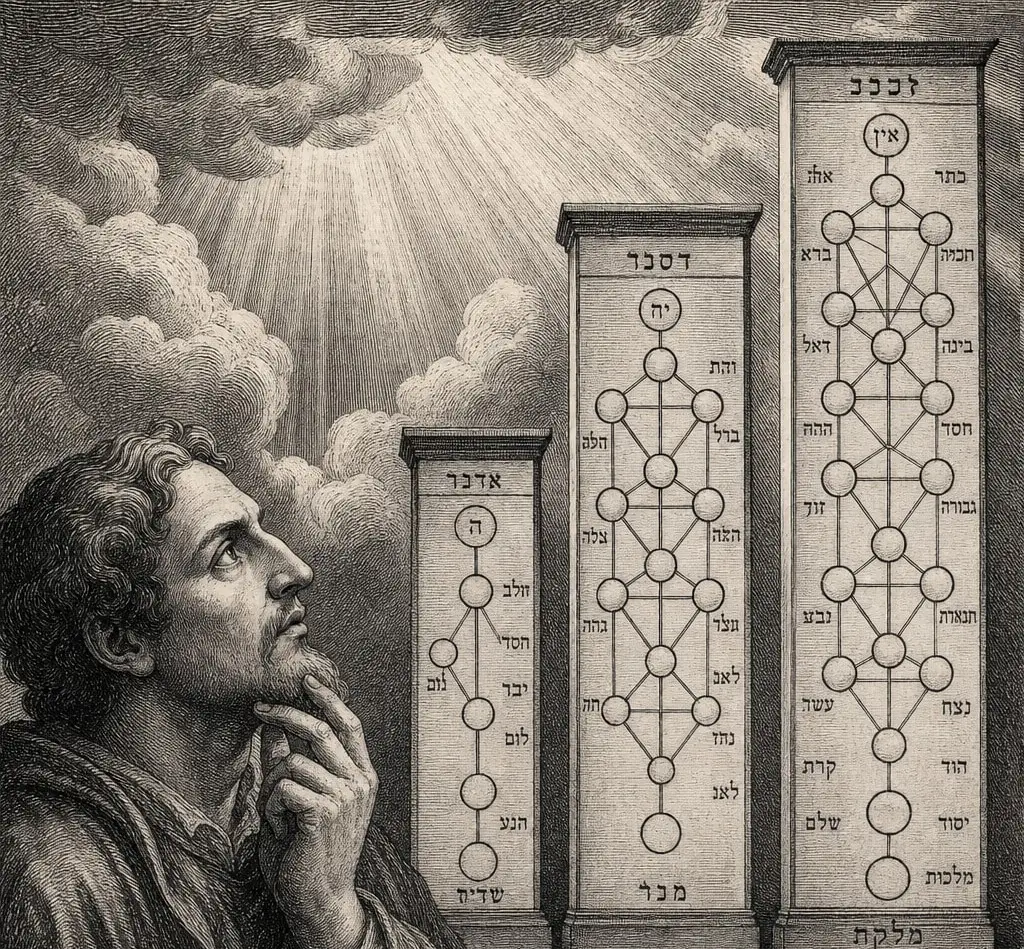
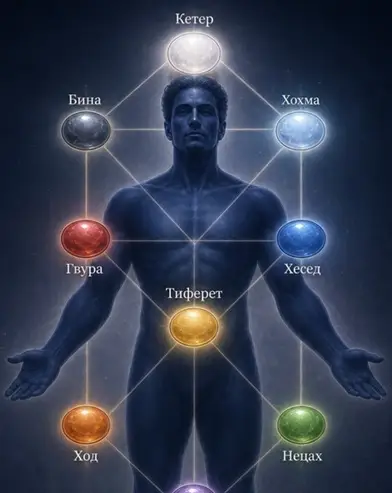
Kabbalah stands as one of the most intricate spiritual and esoteric systems known to humanity. Contrary to the common misconception held by those who have only grazed its surface, Kabbalah encompasses far more than the Tree of Sephirot—though that remains its most fundamental and recognizable component. Kabbalah operates through complex models that describe entire worlds, lights and vessels, direct and reflected light, inner and surrounding light, as well as the veils of reflection and their varying degrees of density or refinement, the collision of lights, the falling sparks, and more. Integral to these models are the sophisticated interactions of partzufim (faces or hypostases), categorized by masculine and feminine, elder and younger aspects. Furthermore, the branches of knowledge dedicated to language—letters and names, their gematria (numerical values), their resonance, and their myriad correspondences—deserve special attention.
This system is detailed in a multitude of dense volumes spanning thousands of pages. These are not merely trite repetitions of simple theses or life advice; they offer a progressively complex description of the aforementioned models, refined down to the finest detail. It is no surprise that most people consider Kabbalah an intensely abstract doctrine. Yet, it remains so only as long as the student overlooks the primary subject to which it is dedicated.
Therefore, it is essential to understand: what is this subject? In doing so, we will also discover the true purpose behind the study of Kabbalah.
Kabbalah posits that all living things strive toward the Good, and that God is the supreme Good. More precisely, God is the only Good, while all other particular forms of goodness are merely distinct manifestations of divine light under varying circumstances. We call this striving toward the Good "Will." Sometimes this term is replaced by "Desire." Although one might draw a subtle distinction between desire and will, in practice, it is often a matter of translation and the adoption of specific terminology. Any "I want" that can arise within a human—or any other living being—is nothing more than a manifestation of Will.
Will constitutes the primary subject of study in Kabbalah. As previously noted, because every Will strives toward the Good, these two concepts become an interconnected pair that loses meaning in isolation; for this reason, they are studied together. These are the very Light (the Good) and Vessel (the Will) so frequently discussed in Kabbalistic tradition.
The Kabbalist's Mindset
The real world we inhabit often strikes us with its complexity and entanglement. Yet it is not merely the external world that is tangled; the human being is equally so. The ancient maxim "Know thyself!" never loses its relevance, for people truly possess little self-understanding, spending their entire lives in the process of learning it.
Accordingly, the Will, which in itself must be something supremely simple, assumes highly complex forms as it encounters various situations. It is in its nature to meet internal and external conflicts, limitations, and conditions to which it must adapt. The Good toward which it strives often seems extremely elusive and distant.
In the real world, Will transforms into the pursuit of specific goals, the realization of which a person perceives as attaining a desired good. However, any Will moving toward its goal inevitably passes through certain stages of manifestation. The existence of a goal implies the existence of specific means to reach it. Different means may serve the same goal, just as the same means may serve different goals. Moreover, one can apply the same means in various ways, yielding different results. All these factors make the realization of Will a complex process, one that often holds surprises for the individual. It is also evident that there is room for many regrettable errors: for instance, one might choose the wrong means for a goal or apply them incorrectly. Alternatively, a person may strive toward a certain goal, believing it will lead to a more significant objective, only to forget the original purpose and continue the pursuit pointlessly, wondering why it brings no satisfaction.
The Kabbalist who studies the laws of Will and Goodness grows accustomed to perceiving their manifestations in reality. The world and the beings that inhabit it become transparent to his gaze, for he understands their Will. One must always remember that pleasure and suffering are reactions of the Will in its interaction with the Good. Simply put, receiving the Good brings pleasure, while its loss brings suffering. Since this is ultimately the only thing that concerns anyone—how to experience pleasure and avoid suffering—the Kabbalist constantly keeps the most essential matter in his focus.
Does this mean we should imagine the Kabbalist as a hedonist, perpetually immersed in pleasure? In a more subtle sense, yes; yet their pleasure stems not from indulging desires, but from understanding and mastering them. This is because one of the fundamental laws of Kabbalah states that the reception of Light depends directly on the capacity to renounce it (a more detailed explanation can be found in a separate article).
Let us now examine several key features of Kabbalistic thought. What must one cultivate within oneself to master this knowledge?
Manifesting the Inner through the Outer
First and foremost, you must learn to perceive every object and phenomenon as a manifestation of something else. Train yourself to view everything as an expression of a deeper reality. When an inner essence manifests through an outer form, Kabbalah calls this garbing (hitlabshut). For instance, meaning is garbed in a word; by hearing or reading that word, we grasp the meaning it carries. Yet, the same word could just as easily garb a different meaning—people often invest identical words with different significance, not to mention that in another language, the same sequence of sounds might express something entirely different. When we encounter a garment, it is vital to ask: what exactly is being garbed within it?
A smile can serve as a garment for joy. But might it also clothe something else? Cunning and guile, perhaps, or embarrassment and shyness, playfulness and flirtation? In life, we learn to distinguish the various shades of a smile to understand what lies beneath them. As you cast your gaze upon different objects, try asking yourself: what is manifesting through them? It is best to begin with man-made objects. Ultimately, the answer to this question will be the specific Will that moved a person to create that object. Try to describe it. Why did people choose to realize this Will in this particular way, rather than another?
Next, you may approach natural objects—those that arose without human intervention—with the same inquiry. Is it possible to grasp the World Will that brought them into being? What did it strive for? What purpose do these objects serve? This task will prove far more difficult than the previous one, yet it is precisely through such exercises that the Kabbalist learns to understand reality.
Similitude and Distinction
The Law of Similarity is one of the most fundamental principles in the cosmos. According to this law, like attracts like, while unlike elements repel. Its manifestations are observable everywhere: in physics, psychology, and society. However, the mutual attraction of opposites is also a frequent occurrence. In such cases, the phenomenon involves a search for wholeness between divided parts; once separated, they perceive one another as distinct and opposite, yet they continue to strive to complete themselves with the missing portion.
The Kabbalist learns to discern the forces of attraction and repulsion that govern the world. In the inanimate realm, this is simpler to grasp, and physics has largely provided the explanation. But can we apply the same understanding to human behavior? For instance, when two people feel drawn to one another, is it because of their similarities or their differences?
Seek more often to identify the similarities between various objects, phenomena, and concepts. Kabbalah constantly operates through analogies and correspondences rooted in a shared likeness. The four letters of the Divine Name correspond to the four elements, which in turn correspond to the four temperaments, the four cardinal directions, the four seasons, and so on. The seven lower Sephirot correspond to the seven planets, the seven days of the week, the seven musical notes, the seven colors of the rainbow, and more. Can we grasp the nature of these correspondences? Often, one must begin with a common attribute. Yet, the explanation may lie at varying depths. Sometimes it stems from a shared origin, or from the fact that the second is a reflection of the first in a different space, or that the first, through its influence, orders the second by recreating an analogous structure within it.
The constant skill of discerning resemblance—even when it is not immediately obvious—enables the Kabbalist to uncover hidden connections in reality and grasp what others overlook.
In many ways, this very complexity of the world has led many "spiritual" teachers to conclude that our reality is an illusion—one that must be dispelled to reveal the truth. For the Kabbalist, however, the world is no illusion; it is a sophisticated order that drives the fool to despair while delighting the wise. Much like a book that conceals its truth from those who cannot read, the world hides the Divine from those who cannot discern its patterns. Yet, we must remember that the same book can become a source of profound revelation. Our life is a continuous journey of growth and the acquisition of wisdom, allowing us to uncover this cosmic order with ever-increasing depth and clarity.
Will: Conflicts and Accord
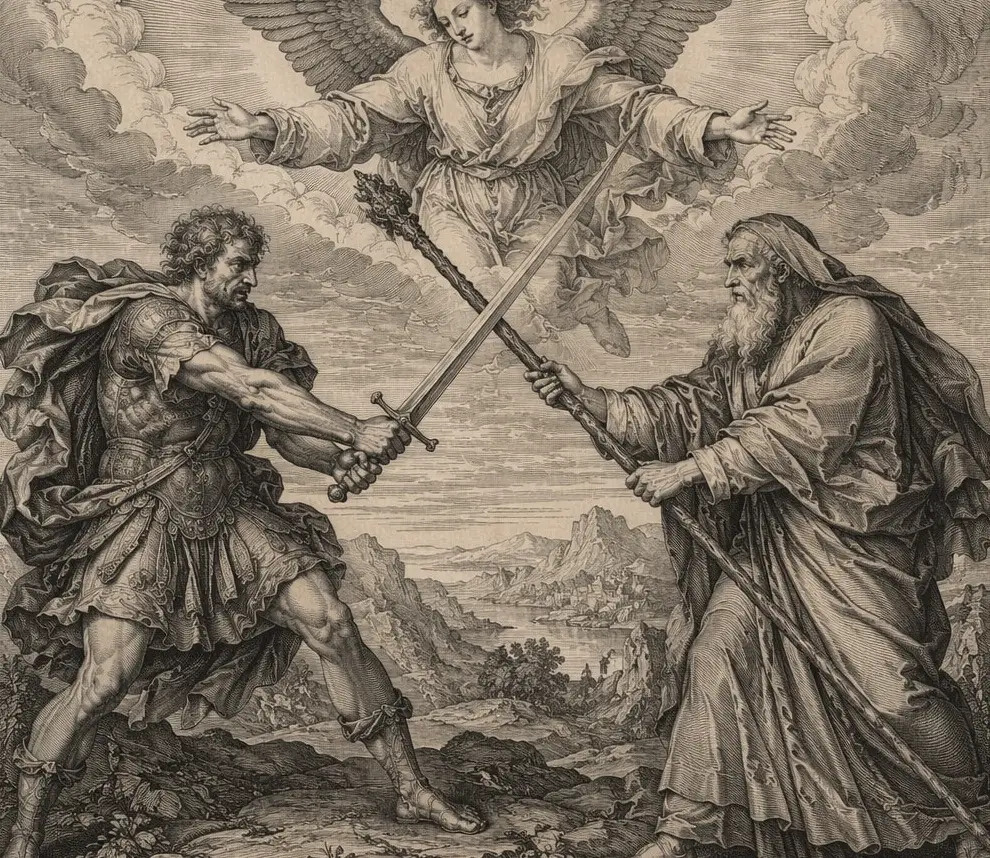
As the Kabbalist studies Will, they always remember that there is no such thing as a Will directed toward nothing. Every Will strives toward a specific goal. Consequently, Wills aimed at the same goal are similar in that regard and can more easily reach an accord. But what happens when two Wills pursue different goals while intending to use the same means? They begin to vie for control over that means, and conflict arises between them.
Conflict and accord are fundamental categories for describing the interaction of Wills. Yet, any conflict can in principle be resolved—though sometimes with great difficulty—if a realization of the conflicting Wills is found wherein both emerge victorious, each attaining its desire.
Will fragments through conflict and unifies through its resolution. This simple principle explains how collective Wills (egregores) arise and why they eventually dissolve. Wills that align perfectly act as one and, in effect, are one, until some distinction manifests within them once again.
Studying conflicting Wills and their behavior reveals the meaning behind many processes and phenomena occurring within and around the human being. When seeking to explain someone's behavior, ask yourself: can this be linked not only to the goal they are pursuing, but also to an existing conflict with another Will? Do not limit your analysis to the actions of an individual—apply the same inquiry to a family, a group, an organization, or a state. Examine how conflicts and their resolutions manifest across different scales, both at the individual and collective levels.
According to Kabbalah, conflict serves in a sense as the engine of the cosmos, triggering the processes of its formation. If the primordial Will, directed toward the Good, could simply possess that Good, nothing else would have emerged in the entire universe; reality would be utterly simple and uniform. Yet, a conflict was embedded at the core of this Will: on one hand, it sought to receive and enjoy the Good; on the other, it desired to be free and independent of it, thereby becoming like the Good itself. The problem lies in the impossibility of being like God in every respect, for God is absolutely free; to be truly free, one must define oneself rather than follow God's example. This logical contradiction required a long process to resolve, which ultimately led to the formation of entire worlds.
Volition and Compulsion
The previous topic—conflicts and consensus—leads naturally to another vital insight regarding the Will. When I desire something, fully aware that it is my own, I act in complete freedom. Yet, what if achieving that desire requires me to accept conditions I did not choose? This introduces an element of compulsion into my realization. Here, the question often arises: where do I end, and where does the 'not-I' begin?
If I want to eat bread, but must first buy it, and to buy it I need money, can I say that earning money is my Will? Is this truly what I desire, or is it a Will imposed upon me? The truth is that in the attempt to earn money in this example, my Will is still active, yet it has been deformed by other wills that have forced it into a state of necessity.
As even a cursory analysis reveals, our lives are woven entirely from such compulsions. The very act of submitting to the laws of the physical world and possessing a body governed by physical principles creates a colossal necessity that constantly shapes the nature of one's Will. In any given situation, however, it is vital to learn how to discern the ratio between the voluntary and the compelled: often, to achieve A, one must perform B, which in turn requires doing C, and so on. The connection between these stages (A → B → C) forms a ladder of steps or a tree of tasks. Sometimes a single major task branches into several parallel minor ones; at other times, several major tasks intersect at a single minor one that satisfies all requirements simultaneously. It is largely through such ladders and trees that Kabbalah operates, demonstrating the connection between one will and another.
Kabbalistic Thinking in Daily Life
Knowledge of the Will, supported by detailed models that describe its aspirations and achievements, its goals and means, its conflicts and harmonies, helps one achieve clarity of self and precision in action. In daily life, people are often dissatisfied or even profoundly unhappy simply because they fail to grasp their true objectives. By substituting false goals for authentic ones, or by failing to see how intermediate steps relate to the ultimate end, they inevitably arrive at results they never intended.
In other instances, he knows his goals but fails to grasp the process of achieving them. He lacks the criteria to choose between potential means and applications, or finds that these criteria do not align with actual circumstances. When reality behaves in ways he did not anticipate, he cannot discern the cause or identify where a correction is required.
Knowledge of Kabbalah helps one not only to better understand one's Will and goals, but also to clearly perceive the blueprint for their realization. Since the laws of Will are universal and identical for all—with only the circumstances of their operation differing—the same model can serve equally well to clarify a wide variety of situations and tasks.
Loading comments...
Sign into leave comments.