
Creating Baron Urbigerus's Herbal Menstruum, Part 2
In the previous article, I described the beginning of the operation involving Baron Urbigerus's vegetable menstruum. We left off at the first conjunction and the start of nourishing our "infant." Three weeks have passed, and at last, the desired substance emerges before us: a well-integrated salt combined with two types of sulfur—the volatile (turpentine) and the fixed (rosin). Saponification has occurred; the salt has softened and reacted with the turpentine and rosin. The substance has taken on a yellowish-white hue, and its consistency resembles a thick paste. The yellowness indicates an excess of fixed sulfur that the salt has not yet absorbed. The true color of the substance is milky.
The Influx of Mercury
Now we must incorporate the final component: the Mercurial agent, or spiritus vini. This is not ordinary alcohol, but a spiritual, rectified wine spirit. Its strength must be at least 90%, as excess water will thwart our efforts to create the menstruum. Water quenches the fiery nature and occupies space intended for something else—a result we cannot permit.
Introducing the Mercury is straightforward: add it to our substance in a ratio of approximately 1:5 or 1:6 and leave the mixture under gentle heat for about 7 to 14 days. It is best not to rush; haste is often the primary cause of failure.
Final Cohobation
Once this time has elapsed, we are ready for the next and final stage: cohobation, which involves repeated distillations and recombinations of the resulting solution. The spirit has now taken its place within the matrix, and the substances have harmoniously distributed themselves into their proper positions.
Using a distiller (I used a round-bottom laboratory flask connected to a bulb condenser angled 45 degrees downward), you will need to perform a total of seven distillations and recombinations. I strongly advise against using an open flame or high heat. The only appropriate methods are a water bath or a heating mantle, should you have one available. The temperature must be regulated so that distillation proceeds slowly, at a rate of roughly 1–2 drops per second. Failure to maintain the proper temperature may lead to negative consequences.
Once nothing more emerges from the condenser, we cease distillation, allow our distillate to cool slightly, and return it to the substance in the flask. It is then advisable to let our "newlyweds" rest for a day, or at the very least, for several hours. We then repeat this process until we have completed seven such cycles.
During the distillation process, you may notice pearlescent globules in the condenser; these are our volatile sulfur—or rather, its excess—emerging alongside the Mercury. They will collect at the bottom of the receiving flask, which is perfectly normal. Their presence indicates that the matrix of the menstruum is saturated and can no longer hold any more sulfur, which is a very positive sign.
Conclusion of the Work
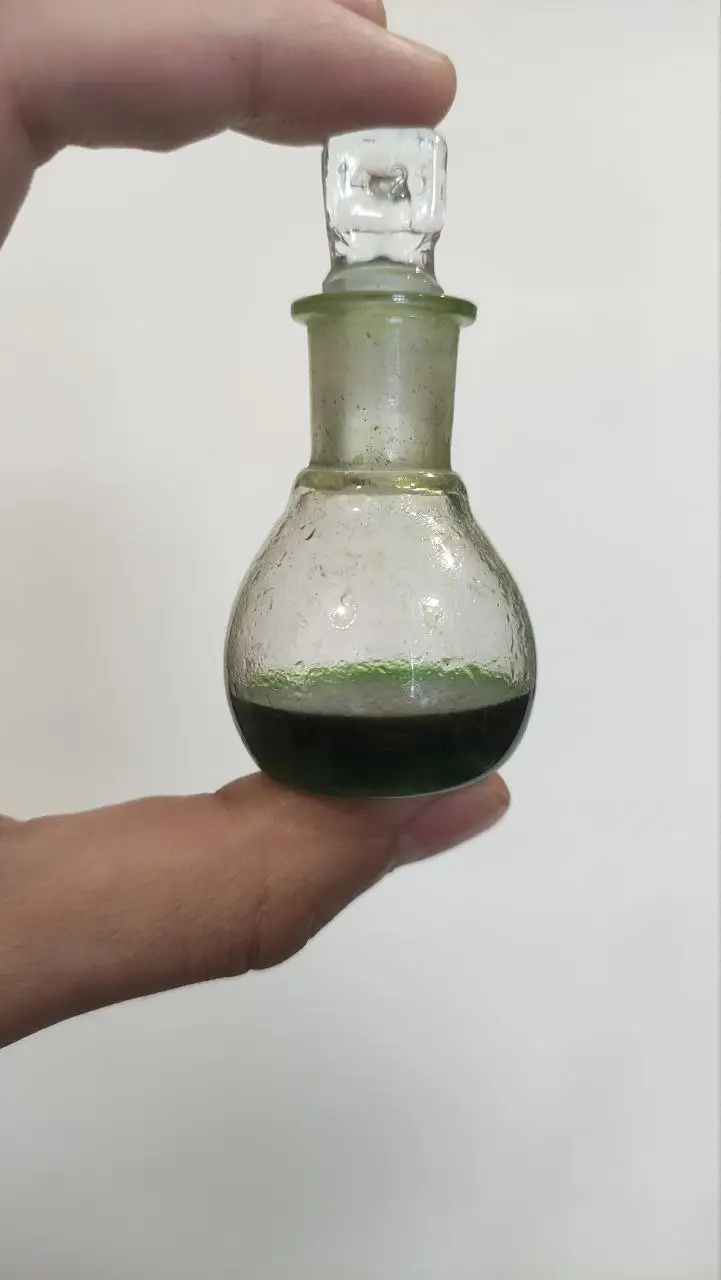
Ultimately, after seven cycles, you will obtain a clear liquid with a faint white tint. Congratulations—this is your menstruum. If you place certain types of fresh, green plants into it, an oily film will appear on the surface within about 10 to 15 minutes. The menstruum has broken the material chains of the plant and liberated its soul. This pure soul, obtained through a gentle, cold process, constitutes a potent medicinal agent whose properties correspond directly to those of the plant used. A couple of drops of this oil produce a noticeable effect.
I personally conducted an experiment with fresh rosemary needles. A couple of drops placed on my tongue instantly granted me a sense of clarity and inner spiritual depth.
Loading comments...
Sign into leave comments.
