Conflict and Its Resolution
According to Kabbalah and Hermetic Philosophy, all living things constantly strive toward the Good. Yet, in the real world, we observe that many living beings suffer. Where do evil and suffering originate if everything is directed toward the Good?
The answer to this eternal question is the word "conflict." Indeed, every soul seeks only the Good, and to achieve this, it strives to emulate the Good through various attributes. For the Good is unified at its root, yet manifold in its manifestations. To us, living in the material world, the Good appears as love, wisdom, strength, health, wealth, freedom, creativity, comfort, and so on. Each of these terms represents a distinct attribute of the Good. It is impossible to determine their exact number; at times, certain attributes appear to be the same thing, merely viewed from a different angle. Often, it is simply a matter of language—of what we choose to call things and how we define them.
We can clearly distinguish the attributes of the Good when we observe how they conflict—or, more precisely, how human wills, directed toward different attributes, clash. In a state of conflict, these various attributes appear incompatible, each hindering the manifestation of the other. Examples include the tension between love and power, freedom and security, or truth and authority. Each such conflict warrants its own analysis; in this article, however, we shall examine the possible relationships between conflicting parties across the various stages of the conflict itself.
Four states, in particular, stand out here:
- Victory / Defeat
- The Struggle
- Compromise
- Resolution
Let us now examine them in greater detail.
Struggle, Victory, Defeat
We typically perceive a genuine conflict only when opponents are actively struggling against one another. However, if the struggle has concluded or has yet to begin, it would be incorrect to claim that no conflict exists; it persists as long as the wills and interests of the parties remain opposed—that is, as long as they hinder the realization of one another. In such cases, the participants may refrain from active struggle, perhaps out of fear that they have more to lose than to gain.
In most cases, a protracted struggle indicates that the opposing forces are roughly equal. Clearly, if one side were significantly weaker than the other, it would avoid conflict—even at the cost of submitting to the stronger party—since defeat promises nothing but ruin, or, having already engaged, it would quickly collapse.
Struggle is, by its nature, an activity where all effort is directed toward a result—victory—and measured by how effectively it achieves that end. Consequently, conflict tends to escalate, for the more effort one invests in winning, the more bitter the taste of defeat becomes, rendering all that labor futile. Thus, the combatants are driven to increasingly desperate measures, desperate to avoid losing at any cost.
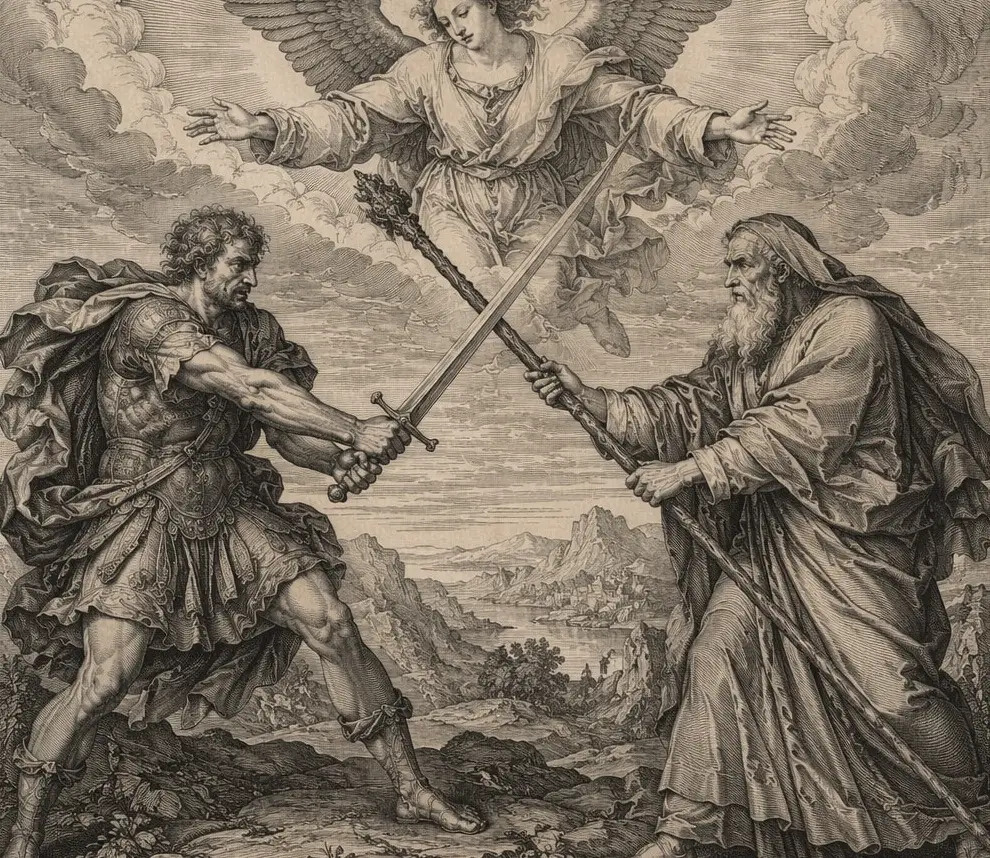
If the forces prove unequal and one side suffers defeat (while the other, consequently, triumphs), the struggle ceases; yet it is vital to understand that the conflict remains unresolved. One of humanity's most profound philosophical errors is equating victory with the resolution of a conflict. In reality, the defeat of one party simply means that its will, having failed to achieve its aim, ceases to manifest. It is displaced from the sphere of the manifest, falling into a "slumber" and awaiting the hour when it can once again surface—perhaps in another form or through a different vessel. The victor, meanwhile, by eliminating all obstacles to the realization of their own will, simultaneously loses the opportunity to reunite with the will of the opponent (which would have occurred had their conflict been resolved).
As a rule, a "win/lose" situation acts as a time bomb, for in the next cycle the loser will seek revenge, while the victor will inevitably collapse.
Compromise and Resolution
The third possible state is compromise, where conflicting parties reach an agreement that requires each to make concessions. Relinquishing a portion of one's claims or ambitions is perceived as a regrettable necessity: while one would prefer otherwise, in the current situation, it remains preferable to open conflict.
To understand the principle of compromise more precisely, one must note that any external conflict inevitably generates an internal one. If I struggle against an opponent, one part of me finds meaning in the fight and insists on continuing it, while another desires an end to the struggle and a return to a state of peace and stillness. Consequently, I lose my inner integrity when I engage in external conflict. In this sense, a compromise represents the victory of the side that votes for peace and the defeat of the side that wishes to fight. The consequences of a "win/lose" situation have already been noted above. This is why compromise is a fragile and unstable state.
In contrast, a full resolution of conflict implies that the previously opposing parties begin to assist rather than hinder one another. In other words, the realization of one party's will also facilitates the realization of the other's. They no longer feel resentment that one allowed the other to have their way; instead, they find joy in giving to each other, as they receive even more through this exchange. In such a state, internal conflict ceases to exist for any of the participants, as their struggle on the external plane also becomes unnecessary.
In practice, we often struggle to distinguish a compromise from a true resolution, as both can appear externally as mutual agreement. Subjectively, the difference lies in the feeling accompanying that agreement: compromise is marked by resentment, while resolution is marked by joy. The subsequent behavior of the parties also differs: in a compromise, I aim to give the other side the bare minimum and stop there if they are willing to accept it. In a resolution, however, I want to give more, because doing so benefits me as well.
External and Internal Conflict
In essence, the principles outlined above apply equally to external conflicts ("I" versus "them," or "us" versus "them") and internal ones (two sides within the self). The fundamental difference is that in an internal conflict, the defeat of either side inflicts pain upon the individual. Regardless of which side prevails, its opposite suffers a loss, meaning the person forfeits a part of themselves. This is why people almost always seek to resolve internal conflicts—unless they have convinced themselves that resolution is impossible—whereas in external conflicts, they more often seek victory. In reality, however, the principle remains the same in every case; an unresolved external conflict will inevitably make its presence felt.
In practice, transitions between the four states described depend on delicate balancing and the cultivation of a proper attitude toward the results achieved. Let us examine this in greater detail through the lens of a common and well-known internal conflict: the tension between work and rest.
First, let us define Will itself more precisely. Rest may be considered an attribute of the Good as such—God abides in immutable rest, for He has no need to exert Himself and nowhere to hasten. Labor, however, undoubtedly pursues a goal. Suppose, in our example, a person works for a wage; they desire money, and thus their will to work is linked to the root of wealth as another attribute of the Good. In essence, we are speaking of a conflict between the will to wealth and the will to rest, which in practice unfolds as a struggle between work and leisure.
If the person in our example is lazy, the will to rest will quickly prevail. He will begin to work less and less, frequently missing shifts, and will likely end up losing his job entirely, remaining destitute and deprived of everything. This is the first of the four states mentioned.
If the will to work—to earn—becomes stronger, a serious internal struggle begins. At times, he will force himself to work harder, and in that moment, he may feel he is advancing toward his goal. Yet, the will to rest will soon strike back, pulling him back into a passive state. He will be tossed between these two poles, his life becoming largely chaotic and unpredictable. The more fiercely these two wills war within him, the more acute this instability will become.
At the next stage of development, the two wills reach an agreement, yet it rests upon a compromise. Our worker has made a firm decision to rest no longer than the allotted time each day, to avoid unhealthy forms of leisure, and to maintain work discipline in parallel. Here, the will to work and the will to rest have learned to coexist; they have settled their differences like neighbors, yet they still harbor ill will toward one another. Often in this state, a person regrets having to spend time on something they do not desire. They feel burdened by necessity, and the compromise forces them to act against their own heart.
Ultimately, this conflict resolves when he asks himself clearly: "Does rest help my work, or does it hinder it?" Clearly, rest can do both. What, then, does it depend on? The answer lies in the form of rest and the time devoted to it. To resolve the conflict of two wills within himself, a person chooses to rest only as much as allows him to work better. By putting this plan into action, he truly sees his work efficiency increase.
Now, when he rests, he no longer feels regret; instead, he rejoices that in this very moment he is doing what will facilitate his work. While working, he finds joy in the fact that he is moving toward the goal of his enrichment, and that his subsequent rest will be well-deserved and untainted by regret.
This example demonstrates that resolving the conflict depended directly on the proper proportion between two sides: modest rest improved performance, while excessive rest hindered it. Naturally, an established balance can falter, causing the situation to slide backward. If, at some point—perhaps due to an external crisis or sudden distress—our worker retreats into rest again, they return their resolved conflict to a state of unresolved tension. Thus, in practice, resolving a conflict of two wills is rarely a static achievement; it requires constant maintenance. Only when this resolution becomes a firm habit, through reconciliation with other potentially challenging wills, can it transform into a monolithic and indissoluble alloy.
The Problem of Evil
Returning to the question posed at the beginning of this article, we can state that evil does not exist as an independent principle in nature. It is human nature to personify evil, endowing it with a name, a face, and a history. However, the Philosophy of Will teaches that all evil is relative and insubstantial. The latter term signifies that evil possesses no essence of its own. Just as darkness is not a separate entity but merely testifies to the absence of light, so too does evil—manifesting as the suffering of living beings—indicate only that their wills toward the Good have failed to resolve their conflicts. No one strives for evil; everyone strives for the Good. It is simply that those who strive often do not know how to reconcile their aspirations with the aspirations of others, or how to reconcile conflicting desires within themselves.
Where there is conflict, suffering inevitably follows. When suffering persists, people label it as evil. If this evil becomes habitual and proves insurmountable, it is then absolutized and viewed as the manifestation of a will inherently dedicated to inflicting pain.
From another perspective, one might say that objective evil is the measure of one's distance from the Good—that is, the degree of immersion in unresolved conflicts. Conflicts fragment the Will into ever-smaller particles, while their resolution reunites these particles into a single whole. Thus, the absolute Good (God) is maximum unity, existing as the resolved conflict of all possible wills. At the opposite end of this scale, one might imagine absolute Evil as a state of maximum fragmentation. However, we cannot define which state of fragmentation should be considered absolute; theoretically, one can always conceive of something worse than any given state.
If absolute Good is an infinitely great Unity, then absolute evil is an infinite Multitude of infinitely small particles.
Bearing all this in mind, one should perceive in every being that particle of the Good which remains within it to the extent that its unity of will persists, and regard any evil it may cause as the consequence of conflicts that are, in principle, resolvable.
Loading comments...
Sign into leave comments.